OEM Perfume Manufacturing in China: Four Trade-Offs for Retail Buyers
Buyers approach OEM perfume manufacturing in China looking for a price, and discover a set of trade-offs instead. Cost moves against range breadth, speed moves against compliance depth, and price moves against how much of the formula you own. None of these trade-offs is a problem to be solved; each is a position to be chosen deliberately. A retailer's own brand that names its position on all four before briefing a factory usually gets a programme that matches the business rather than a programme that matches the quotation.
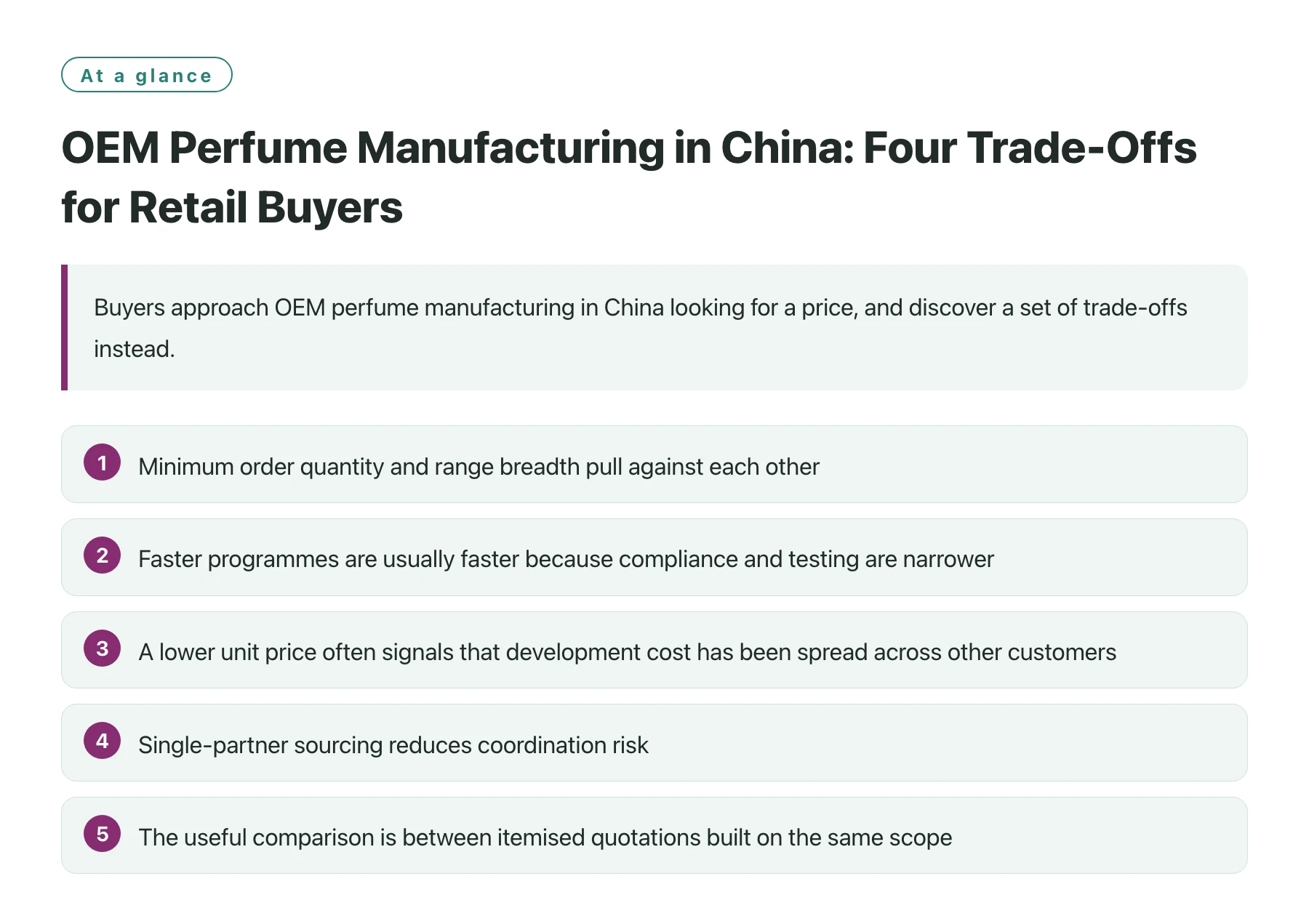
Key takeaways
- Minimum order quantity and range breadth pull against each other, and the retail shelf usually decides which one gives.
- Faster programmes are usually faster because compliance and testing are narrower, not because the factory is better.
- A lower unit price often signals that development cost has been spread across other customers, which affects exclusivity.
- Single-partner sourcing reduces coordination risk; specialist sourcing can reduce component cost, at the price of owning the interfaces.
- The useful comparison is between itemised quotations built on the same scope, not between headline unit prices.
China supplies fragrance manufacturing at a wide range of price points, and the price differences are rarely about competence. They reflect different positions on cost, speed and ownership, and those positions have consequences for a retailer's own brand.
This article sets out four trade-offs and the signal each one sends in a quotation. It is written from the buyer's side of the table, which means it spends more time on what you give up than on what you gain.
Why there is no cheap, fast and flexible option
Manufacturing economics do not leave much room for a supplier that is simultaneously inexpensive, quick and accommodating. Capacity is scheduled, materials are bought in lots and development time is finite, so an offer that appears to be all three is usually strong on one, adequate on the second and vague about the third.
That is not a reason to distrust a quotation. It is a reason to read it as a position. A factory such as Xuelei OEM perfume manufacturer in China that both develops and produces can absorb some of the friction between development speed and production cost, because the same team carries the formula from bench to line. It cannot remove the trade-off between range breadth and minimum order quantity, which is set by the filling line, not by goodwill.
Four trade-offs, and what each one costs you
None of the four is a defect in the market. Each is a position that a supplier takes and a buyer chooses, and each one is cheaper to choose deliberately than to discover in month three.
Trade-off 1: unit cost against range breadth
Minimum order quantities in fragrance are driven by setup: compounding, cleaning, filling and component purchasing each have a minimum economic run. Ask for a low minimum on a five-scent range and the price per unit rises, because the same setup is spread over fewer bottles.
The retail decision behind this trade-off is usually made by the shelf rather than the factory. If the store plan can carry three scents at volume, a narrow range wins. If the range has to look complete to be credible, accept a higher unit cost or expect to hold stock.
One useful middle path is a shared pack across the range. A common container and closure reduces tooling and component minimums, which lets a slightly wider range exist at a lower unit price.
Trade-off 2: launch speed against compliance depth
A programme that reaches shelf in ten weeks is usually one where testing, stability work or documentation has been narrowed, deferred or absorbed by the buyer. Ask which of those it is. A cosmetic product placed on a market has to meet that market's requirements regardless of how quickly it was produced [1], and the requirements do not compress because the calendar did.
The practical version of this trade-off is a decision about which tests happen before launch and which happen in parallel with the first production run. That is a legitimate choice; leaving it unnamed is not. In fragrance work, odour and stability evaluation is normally carried out against a reference under controlled conditions, which is precisely the kind of work that gets squeezed when a calendar is compressed [4].
Trade-off 3: price against ownership
A very competitive unit price frequently means the scent already exists in the manufacturer's library and is sold to more than one customer. That can be an excellent outcome for a retailer testing a category, and a poor one for a retailer building a distinctive own brand. Ownership, exclusivity and the right to move production later are contract subjects, not price subjects [2].
The question to ask is direct: is this formula exclusive to us, for how long, and in which markets? A clear answer is more valuable than a small price difference.
Trade-off 4: one partner against specialist suppliers
A single partner covering development, compounding, filling, decoration and packing removes internal handovers, which is where most delays live. A split supply chain can reduce component and decoration cost, because specialists compete at each step, but the retailer then owns every interface: fit, seal, colour, timing and liability.
For a first own-brand range, the coordination risk usually outweighs the component saving. For a mature programme with an experienced packaging team, splitting can be worth the saving. Retailers positioning at the top of the market should note that a manufacturer for luxury fragrance brands is not simply a supplier with better materials; the finish and consistency expectations apply to the whole chain, which is harder to hold across separate vendors.
The four trade-offs side by side
| Choice | What you gain | What you give up | Usually worth it when |
|---|---|---|---|
| Low unit cost, library scent | Speed and a predictable price | Distinctiveness and, often, exclusivity | You are testing a category or filling a price tier |
| Wide range, low minimums | A complete-looking shelf presence | A higher unit cost and more stock risk | The store plan needs a family to read as a range |
| Fast launch, narrower testing | An earlier shelf date | Documentation depth and some flexibility later | The season is fixed and the pack is already proven |
| Split supply chain | Component and decoration savings | You own every interface and every delay | You have packaging resource and volume to justify it |
| Custom development, owned formula | A distinctive product and freedom to move | Higher development cost and a longer calendar | The own brand is central to the retail proposition |
Read the table as a set of positions, not a ranking. Most retail programmes end up choosing different positions for different parts of the range.
Reading a China quotation without being misled
The comparison only works when the quotations describe the same scope. Ask every shortlisted supplier to itemise development, compounding, filling, components, decoration, testing, packing and freight, and to state the assumptions behind each line: volume band, lead time, payment terms and what triggers a price review. Component and freight costs move, which is why quotations carry validity periods and why a price that was accurate last quarter may not hold this one [3].
A supplier acting as a contract manufacturer for perfume brands will usually be comfortable with that format, because it is how the programme will actually be managed. A supplier that only quotes a unit price is either very experienced with your exact product or has not costed the project.
It is also worth checking how the supplier describes past work rather than how it recounts it. Reviewing Xuelei case studies and asking which trade-off each project took, and why, tells you whether the supplier makes those choices consciously. Buyers who ask that question tend to get fewer surprises in month three.
Finally, keep the trade-off decisions visible to the business. A narrow range at a low unit cost is a sourcing decision with a merchandising consequence, and the buying team should see both halves of it before the purchase order is raised.
Ask any supplier which of the four trade-offs its quotation has taken, and what the alternative would cost. Suppliers that can answer quickly are usually the ones that will handle a mid-programme change without treating it as a crisis.
Sources
- European Commission: Cosmetics in the EU —— The European Commission's overview of EU cosmetics rules, including the responsible person, product information file and safety report requirements.
- WIPO — World Intellectual Property Organization —— The UN agency for intellectual property; resources on industrial design and patent protection relevant to product and packaging design.
- HAPPI — Household & Personal Products Industry —— An industry magazine covering the household and personal care market, including fragrance, formulation and packaging.
- Cosmetics & Toiletries —— A technical magazine for cosmetic formulators, covering ingredients, formulation science and testing methods.
Frequently asked questions
Is OEM perfume manufacturing in China cheaper than domestic production?
Often, at volume, because component supply and filling capacity are concentrated. The saving narrows on small runs, on unusual components and when freight and import costs are included. Compare landed cost per unit on the same scope rather than ex-works price.
Why are minimum order quantities so much higher for some scents?
Setup cost is the usual reason. Compounding, cleaning and filling each have a minimum economic run, and components such as custom bottles or decorated closures add their own minimums. A scent that uses an existing pack and a library formula will have the lowest minimum.
How fast can a first OEM order in China be produced?
Ten to twelve weeks is possible when the scent is already established, the pack is standard and testing runs in parallel with production. A custom pack or a new formula extends that considerably, and the extension comes from tooling and development rather than from the factory's speed.
Does a lower price mean the formula is shared with other customers?
It can. Library formulas are typically sold to multiple customers, which is legitimate and often appropriate. If exclusivity matters to the brand, it has to be purchased and written into the contract, along with the duration and the markets covered.
Should a retail own brand use one supplier or several?
For a first range, one partner is usually safer because it removes internal handovers. Once the range is established and the retailer has packaging expertise in house, splitting component or decoration supply can reduce cost as long as someone owns the interfaces.