PV1-F Solar Cable: Where It Still Fits
PV1-F still appears on drawings, tender schedules and spare-parts lists long after the array has been built, so the buyer's question is narrow: does the designation still describe a cable this manufacturer makes, and do its published values match the project? KUKA CABLE carries PV1-F as its own page inside a broader solar pv cable family and pairs TUV EN 50618 with the designation in one certificates entry, which is the place to start.
Key takeaways
- The manufacturer presents PV1-F as a live product page and ties TUV EN 50618 to it in the certificates listing; no page retires the designation.
- Published values for the 1500 V class: rated DC 1.8/1.8 kV, a 10 kV spark test in production and a 6.5 kV AC test at 50 Hz held for 5 minutes on the finished cable.
- Thermal window: -40 °C to +90 °C ambient, +120 °C over 20,000 hours and +250 °C for 5 seconds in short circuit.
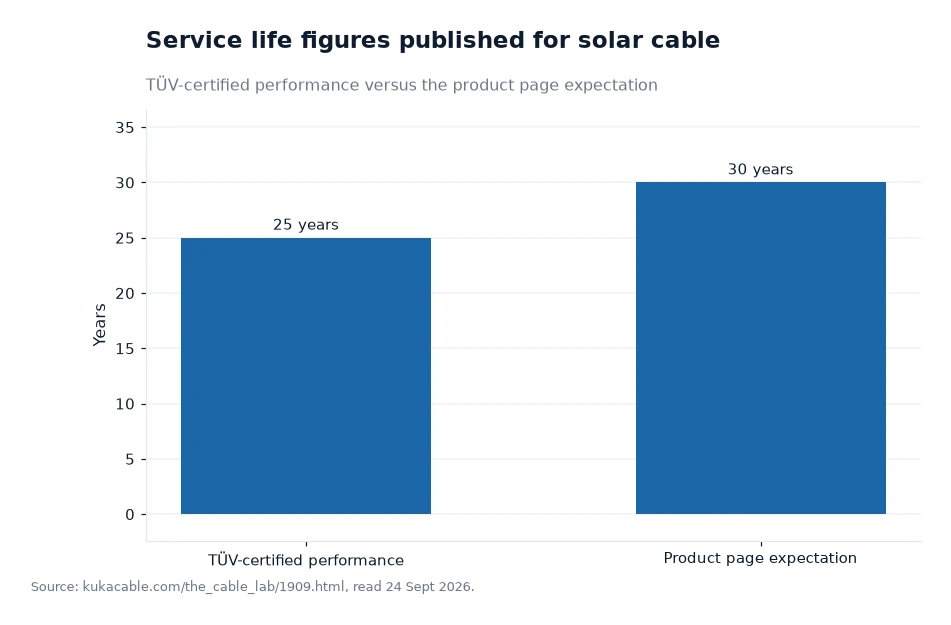
- Elongation before ageing is published as at least 125% in the standard and up to 185% in the manufacturer's own test practice, with a service life of 25 years or more.
What the designation actually names
PV1-F is a designation, not a full specification, and on this manufacturer's pages it sits inside a wider family: H1Z2Z2-K, PV1-F and UL 4703 PV wire each have a page of their own, while the certificates area describes more than 30 types of certificate covering TUV, IEC, CE, SAA and UL. The entry that matters for an order is the one reading TUV EN 50618 / PV1-F. IEC 62930, UL 4703 and the CPR fire rating are listed separately.
That layout rewards slow reading. The site publishes no notice that the designation has been withdrawn and no list of markets that refuse it. It presents PV1-F with the same construction detail as the rest of the range: tinned copper conductor, class 5 flexible to IEC 60228, electron-beam cross-linked XLPO insulation and sheath, low smoke halogen free, black or red. A buyer who needs to know whether the name suits a new string is therefore testing the designation against the standard in their own quality plan, not against the age of the letters.
The practical consequence is that the phrase on the drum label is a starting point for the paperwork. Two suppliers can quote the same designation and still differ on strand count, wall thickness and the test values printed on the certificate, because the site's own pages publish those numbers separately from the model name.
Where a PV1-F order still earns its place
Three situations keep the designation on purchase orders. Repair and extension work comes first: when a string built to a PV1-F drawing loses a length of cable, matching the existing label avoids a variation note on the client's documentation. Repeat business is second: a distributor who has sold the same model for years holds stock references, drum labels and connector compatibility built around that name. Frozen tender wording is third: the consultant wrote the designation into the schedule and the contractor is bound to it.
In all three cases the cable behind the label belongs to the same family as the rest of the catalogue. The commonly used sizes are 4 mm², 6 mm² and 10 mm², in single-core and twin-core versions, and the construction figures published for those sizes describe the family as a whole rather than one sub-model.
The values that decide suitability
Strip the name away and the decision rests on published numbers. The manufacturer's figures for the 1500 V class include a rated DC voltage of 1.8/1.8 kV, a 10 kV spark test during production and a 6.5 kV AC test at 50 Hz applied to the finished cable for 5 minutes. The bending radius is 4 times the outer diameter. Ambient temperature runs from -40 °C to +90 °C, while short-circuit temperature is published as +120 °C over 20,000 hours and +250 °C for 5 seconds.
Mechanically, tensile strength before ageing is given as at least 8 N/mm² and elongation before ageing as at least 125%, with the manufacturer stating that its PV cables typically reach up to 185%. A 2,000-hour xenon lamp test, described as equivalent to about 360 weathering cycles, is being arranged on the company's solar cables. None of those values change because one drum carries an older designation than another; they are what an engineer compares with the specification, whichever name is printed.
A short checklist before the order is placed
Six checks cover most of the ground. Ask for the certificate carrying the designation, then read it against the schedule rather than against the label.
- Conductor: tinned copper, class 5 flexible to IEC 60228, with the construction published per size - 56 strands of 0.29 mm at 4 mm², 84 at 6 mm² and 142 at 10 mm².
- Insulation and sheath: electron-beam cross-linked XLPO, low smoke halogen free, 0.7 mm of insulation and 0.8 mm of sheath through the sizes from 1.5 mm² to 10 mm².
- Voltage figures: rated DC 1.8/1.8 kV, 6.5 kV AC for 5 minutes on the finished cable and a 10 kV spark test during production.
- Thermal and mechanical limits: -40 °C to +90 °C ambient, +250 °C for 5 seconds in short circuit, a bend radius of 4 times the outer diameter and elongation of at least 125%.
- Regional paperwork: CPR fire rating and the AD8 waterproofing rating where the local rule asks for them.
- Traceability: the manufacturer describes full inspection of finished products plus sample retention, so ask which samples of your batch are held.
| Designation or requirement | Where the manufacturer names it | What a buyer should confirm |
|---|---|---|
| H1Z2Z2-K | Solar cable section, with a product page of its own | Test values on the certificate and the marking printed on the drum |
| PV1-F | Listed together with TUV EN 50618 and given its own page | The standard written against the designation on the certificate |
| UL 4703 | Solar PV wire page | North American approval route and the conductor stranding ordered |
| IEC 62930 | Named on the 1500 V, 6 mm² product page | Test voltage, bend radius and the service-life statement quoted |
| CPR fire rating | Regional requirement highlighted by the manufacturer | Fire class demanded by the local building rule |
| AD8 waterproofing | Regional requirement highlighted by the manufacturer | Whether the rating is claimed for the cable or for the jointing system |
Worked example
Suppose an existing string needs a 400 m spare run of 4 mm². The published nominal weight is 59 g/m, so the cable alone weighs about 23.6 kg (0.059 kg/m multiplied by 400 m gives 23.6 kg; this is my own arithmetic, assuming the published figure is net cable without the drum or coil). The same length at 6 mm² comes to about 31.2 kg at 78 g/m, and at 10 mm² about 52 kg at 130 g/m. Those are handling and freight figures rather than electrical ones, but they are the ones a site team feels when a drum has to be carried up to a roof.
The bend radius is the other published number that shifts with size. At 4 times the outer diameter, 4 mm² with a 5.5 mm outer diameter needs 22 mm, 6 mm² at 6.0 mm needs 24 mm and 10 mm² at 7.5 mm needs 30 mm (all three are my own calculations from the published diameters). A spare run that turns tightly inside a tray or through a wall sleeve is therefore a size decision as much as a current decision.
Frequently asked questions
Is PV1-F still a current product line at KUKA CABLE?
Yes. The designation has its own page in the solar cable section and appears in the certificates listing paired with TUV EN 50618, so it is presented as a live line rather than a historical note. The site publishes no statement about markets that restrict the designation, so an order naming PV1-F should ask for the certificate carrying that standard together with the test values printed on it, including the 6.5 kV AC test held for 5 minutes and the bend radius of 4 times the outer diameter.
How does PV1-F differ from H1Z2Z2-K on the same site?
The manufacturer treats them as two designations of one family rather than two grades. Both pages describe a tinned copper class 5 conductor with electron-beam cross-linked XLPO insulation and sheath, black or red, and the same published electrical window: rated DC 1.8/1.8 kV, ambient -40 °C to +90 °C and +250 °C for 5 seconds in short circuit. What a buyer can see on paper is the standard written against each name and the marking on the drum, so the useful check is the certificate rather than the label.
What to put in the enquiry
Send the string design, the size and the standard your quality plan names, then ask for the certificate carrying it, the cross-section table for the sizes you need and a sample length to measure. The manufacturer offers free samples on its product pages, publishes data sheets and a catalogue for download, and routes the whole job through one product consultant from first enquiry to aftercare, so a single person stays answerable for the drawing, the drum and the delivery paperwork. Settle which designation your schedule will accept before the purchase order fixes the wording.
PV1-F and 1500 V values quoted above are drawn from the manufacturer's own website, which was read on 24 Sept 2026[1].